
Back on the fence
In January 1991 Remsen Wolff, who lived his last years as Vivienne Blum, took me to New York for the first time, as his assistant. The war in Iraq (that's the first American war in Iraq) was about to start. He gave me a whistle, against gay-bashers. That was the danger then: strangers, on a corner, at night. And the defence was a whistle around my neck.
On May 16th 2026 Special Girls: A Celebration went up on the fence of Corporal John A. Seravalli Playground in the West Village. It was part of Photoville's fifteenth anniversary festival, curated by Hedy van Erp. Three banners. Fifteen portraits of thirteen people, made by Remsen Wolff in New York and Amsterdam between 1990 and 1995.
In the early hours of August 5th 2026 two of the three banners were cut off the fence. Vandalism. It was filmed. It was reported. The police have the footage and are investigating.
The About page of this site has said since May: "the climate the work is being released into is not the climate it was made in." That was written before any of this happened.
That climate is not a feeling. It is policy. An executive order that says there are two sexes and nobody else. Your passport can no longer say who you are. You are banned from the military. And in the Netherlands we have seen it up close. In the spring of 2025 the American government took two panels out of the exhibition at the war cemetery in Margraten, in Limburg. One told the story of a Black soldier who died saving a comrade in 1945. The other described segregation in the American army. The reason, in the government's own emails, was the order against diversity. (1)
In 1991 the hate came from strangers, and the government was not on their side. Now it leads by example. Its method is simple. First it decides on a category. Then it removes everyone in it. On August 5th thirteen people were removed from a fence. I can see the resemblance.
Remsen worked the other way round. He refused the category for himself first. While working on Special Girls he wrote in his diary that he was "a male who rejects the term man." In 1986, before he ever brought a sitter into the studio, he photographed Ichiro Kishimoto at the Tompkins Square Park Arts Festival, blindfolded, with a hand-lettered board: Please don't arrest me. I'm just walking on the "Public" space. I'm not performing. The quotation marks were the subject: who is allowed to exist in public? Quentin Crisp, who sat for him, wrote in 1991 that these people "hold their place in the modern world and enliven what might, without them, be a drab scene."
He went through the category and found the individual inside it. One at a time, each with a name. That is what portraiture is. What was cut was not an issue. It was portraiture. The cutting made thirteen individuals into one thing again. That is the one thing this work refuses to do.
Eleanor Roosevelt, the one politician Remsen ever liked, never ran for anything in her life. She chaired the commission that wrote the Universal Declaration of Human Rights. She asked where universal human rights begin, and the answer she is remembered for: in small places, close to home, so close and so small that they cannot be seen on any maps of the world. The world of the individual person.
Photoville weighed the days that were left. I wrote back that the arithmetic measured the wrong thing. A removal is not undone by time. It is undone by the work being back where it was taken from. (2) Photoville said yes. Thank you! The work stays there until September 8th, when the permit ends.
I do not know who did it, or why, and nobody has told me. And I am not going to guess. But I am not going to pretend I do not know what it looks like either.
There was a woman in my life called Anita Leeser. She was hidden in my grandparents' house in Amsterdam in 1944 and she survived the war. She later became vice-president of the Amsterdam court, where nobody is guilty until it is proven. She died last October. Her motto: "Don't act like a victim, act like a survivor."
My father, Marten Brouwer, was a political psychologist. He spent his life studying how publics form their opinions. He said: Mensen zijn niet slecht, maar laf. People are not bad, but cowardly. Eleanor Roosevelt wrote in 1944: "If silence seems to give approval, then remaining silent is cowardly." That is why this page exists.
Two banners were cut. Now they are back: thirteen people, one at a time, each with a name. The answer to erasure is a name. The show is called A Celebration. It went back as one.
This work, these portraits, those people, Amanda Lepore, Catherine Harkness, Chelsea, Christian Womyn, Dayle Licious, Frederica, Goldie, Kabuki Starshine, Lucille Balls, Miss Volva, Paris, Ryan Colby, Terence and Remsen Wolff, are back on that fence.
Jochem Brouwer
Steward, The Remsen Wolff Collection
Amsterdam, August 28th 2026
With thanks to Photoville, who put the work back; to the Consulate General of the Kingdom of the Netherlands in New York and DutchCultureUSA, whose support helped pay for the banners; to Hedy van Erp, who curated them; and to the person who first saw the damage and raised the alarm.
NOTES
1. The removal at Margraten was reported by the Jewish Telegraphic Agency and Dutch News in December 2025, from emails obtained under the Freedom of Information Act.
2. Research on imitation finds that coverage of an act can hand a method to somebody who already has the motive; it does not create the motive (Ray Surette, on copycat crime). The professional body for public art in the United States advises the opposite of silence: repair damage quickly, because damage left standing invites more (Americans for the Arts, Public Art Network). What can be copied is a removal that stands. A reprint that exists cannot be copied, however short its run.
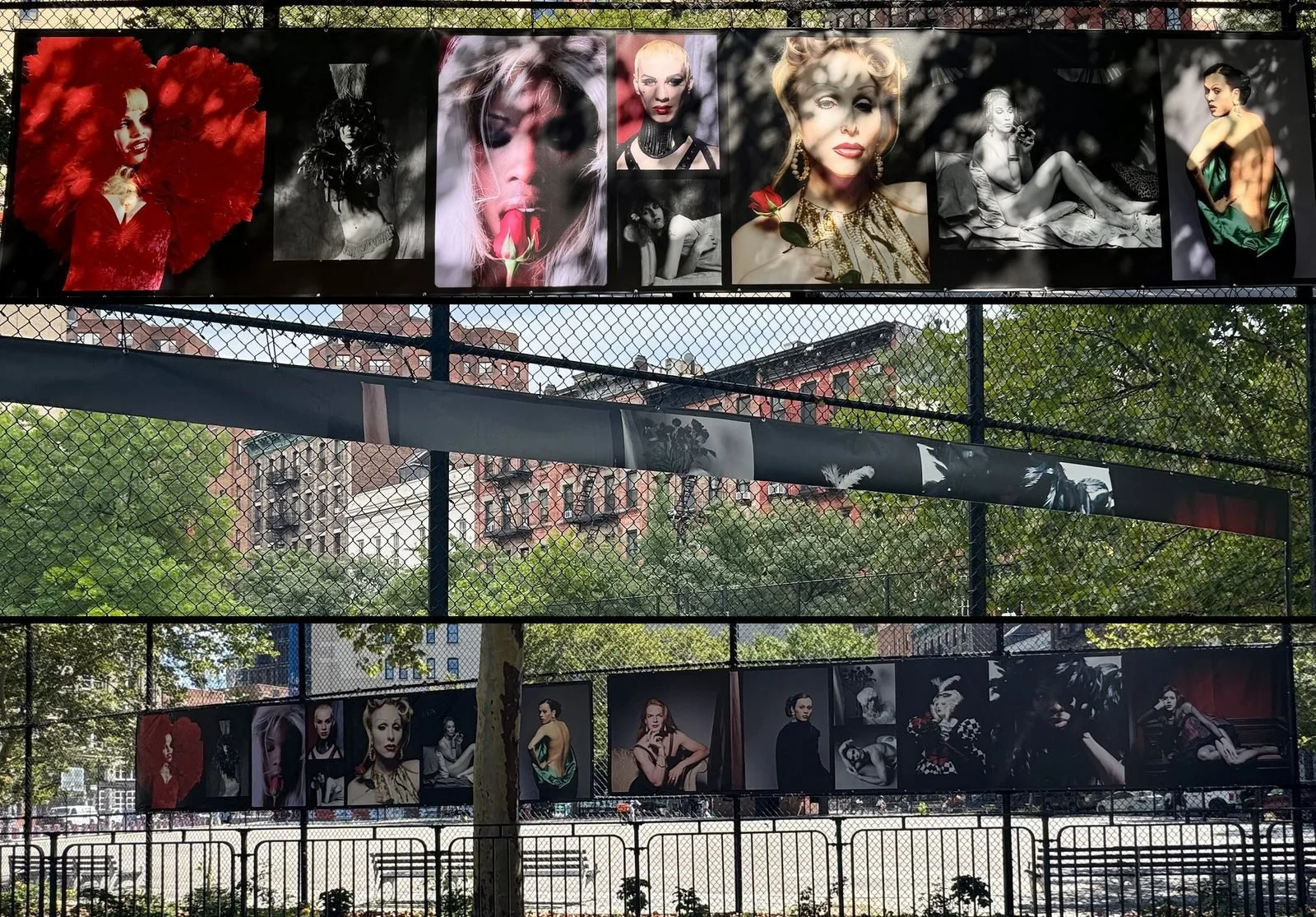
Special Girls: A Celebration at Corporal John A. Seravalli Playground. Before, August 5th 2026, August 26th 2026. Photos: Jochem Brouwer, Yonatan Safit and Dave Shelley (Photoville)

Ichiro Kishimoto, Tompkins Square Park Arts Festival, East Village, 1986